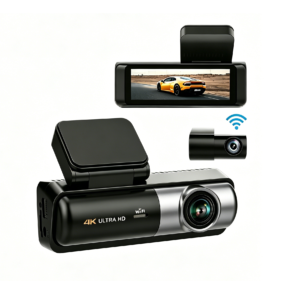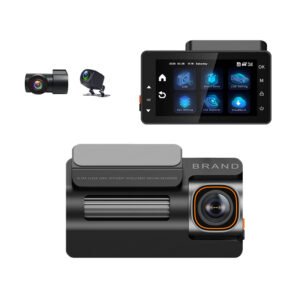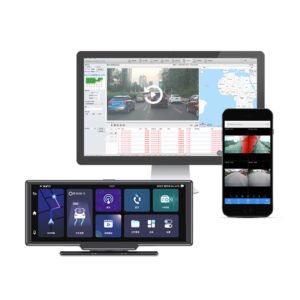
When fleet camera specs say “ADAS” and “DMS”, they are describing two completely different AI systems that happen to live in the same recorder: ADAS watches the road ahead; DMS watches the driver. One prevents collisions caused by the world outside the windshield; the other prevents incidents caused by the human behind the wheel. Together they are the “AI” in an AI fleet dash cam. Here is what each one actually does, how it works, and which you need.
ADAS = Advanced Driver Assistance System
ADAS uses the road-facing camera (and sometimes the vehicle’s own data) to analyze the traffic environment in real time and warn the driver before a collision. In a dash cam it typically includes:
- Forward Collision Warning (FCW) — alerts when you are closing on the vehicle ahead too fast.
- Lane Departure Warning (LDW) — alerts when drifting out of lane without a turn signal (drowsiness or distraction).
- Pedestrian / Vehicle Proximity Warning — detects vulnerable road users and vehicles in the path.
- Headway / Following-Distance Warning — warns when tailgating.
- Urban/Low-speed collision warning — stop-and-go traffic protection.
- (On some models) BSD — Blind Spot Detection — warns of vehicles alongside during lane changes.
The camera feeds frames to an on-board AI processor that identifies lane markings, vehicles, pedestrians and distance; when a risk threshold is crossed, the driver gets an immediate audible/visual warning — and on connected fleet units, the event is logged and uploaded to the platform. ADAS addresses the external risk: someone else brakes hard, a pedestrian steps out, traffic slows abruptly.
DMS = Driver Monitoring System
DMS uses the driver-facing (cabin) camera — usually with infrared illumination so it works at night and through sunglasses — to analyze the driver’s face and behavior. Typical functions:
- Fatigue / drowsiness detection — eye closure, long blinks, yawning, head nodding; triggers escalating alerts and often a platform report.
- Distraction detection — looking away from the road, head turned, phone interaction.
- Phone use and smoking detection — common fleet-policy violations, captured as timestamped evidence.
- Seatbelt and (on some units) mask/identity checks — compliance and driver identification.
- Real-time in-cab alert — a buzzer or voice warning the moment the behavior occurs, plus a clip and score sent to management.
DMS addresses the internal risk: the driver themselves. Statistically this is the bigger lever in fleets — the overwhelming majority of commercial-vehicle accidents involve driver error, fatigue or distraction. Our comparison of DMS vs traditional dash cams covers the safety impact in detail.
ADAS vs DMS at a Glance
| ADAS | DMS | |
|---|---|---|
| Watches | The road ahead | The driver |
| Camera | Front/road-facing | Cabin/driver-facing, IR |
| Prevents | Collisions, lane drift, pedestrian strikes | Fatigue-, distraction- and behavior-caused incidents |
| Alerts | FCW, LDW, headway, BSD | Drowsiness, phone, smoking, no seatbelt |
| Needs | Good road camera + calibration | IR cabin camera + AI processor |
| Best for | All drivers; highways, urban delivery | Long-haul, coaches, hazmat, high-risk fleets |
How They Work in a Fleet System
Both systems run on the recorder’s built-in AI chip (no cloud round-trip needed for the warning itself — latency has to be milliseconds). What goes to the cloud — over the unit’s 4G connection — is the event: a short clip, the alert type, GPS location, speed and timestamp, which appears on the fleet manager’s platform (CMSV6-compatible on our units). Events accumulate into per-driver safety scores and coaching reports. That loop — instant in-cab warning plus post-trip management data — is what turns a camera into a safety program, and it is why AI cameras measurably cut incident rates (see why fleets are moving to AI dash cameras and the accident-cost numbers).
Do You Need Both?
- Long-haul trucking, coaches/buses, hazmat, night operations: specify both ADAS and DMS — fatigue is the #1 risk and road collisions are the costliest.
- Urban delivery, vans, service fleets: ADAS (FCW/LDW/pedestrian) delivers the most value; DMS if driver behavior is a known issue or insurance requires it.
- Rideshare/taxi: DMS + cabin channel for driver/passenger incidents; ADAS as a bonus.
- Personal / executive vehicles: ADAS-oriented models (often marketed with BSD) are available without the fleet platform — e.g. the YS08 premium 4K with ADAS & BSD, the YS06 4K with ADAS and blind-spot detection, or the YS11 4K safety cam with ADAS for driving-school/insurance use.
- Channel count: full ADAS + DMS needs at minimum road + driver cameras; 3–4 channel builds add rear/cargo coverage (what 4-channel systems are used for). And note ADAS/DMS sit on top of the fleet-camera workflow described in our fleet dash cam overview.
Our ADAS/DMS Models
- 4-Channel AI Fleet Cam with DMS + ADAS: full AI stack — DMS driver monitoring, ADAS road warnings, GPS, 4G reporting — for high-risk fleets.
- YC06 — 4G 4-Channel Fleet Dash Cam: flagship with CMSV6 streaming and optional ADAS/DMS, so fleets can enable AI where routes require it.
Bottom Line
ADAS is the camera watching the road for you; DMS is the camera watching you for the road. ADAS prevents outside-in collisions with instant warnings; DMS catches fatigue and distraction — the root cause of most fleet accidents — and feeds coachable data to management. For serious commercial fleets the two are complementary, and units that include both are rapidly becoming the safety-spec standard.
Specifying ADAS/DMS Fleet Cameras?
Yeshi Tech manufactures AI-enabled fleet dash cams with ADAS road warnings and DMS driver monitoring (fatigue, distraction, phone use, smoking), 4G cloud reporting on CMSV6 platforms, GPS and 3–4 channel coverage. We supply fleets, telematics partners and distributors with tiered pricing, OEM branding, platform accounts and samples. Tell us your vehicle types and safety requirements — quote within 24 hours.
Email: sales01@yeshi3c.com
WhatsApp: +86 134 2511 8418
Address: Room 1006, Xianke Industry Building, Bagua 4th Rd, Futian District, Shenzhen, 518029, China