
A regular dash cam is a black box that records to an SD card: useful after an incident, if someone physically pulls the card. A 4G dash cam is a connected device that streams, uploads, tracks and alerts in real time over the cellular network — turning the camera from a passive witness into a live fleet-management terminal. If you have ever wondered what a 4G dash cam actually is, how the data gets from the truck to your screen, and whether you need one, here is the plain-English explanation.
What Is a 4G Dash Cam?
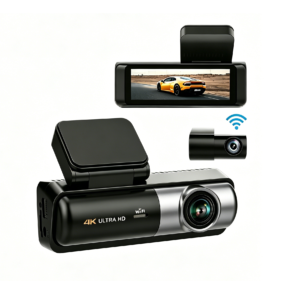
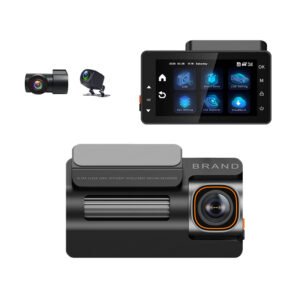
A 4G dash cam is a dash cam with a built-in cellular modem (4G/LTE) and a SIM card slot. It records video locally to an SD card like any dash cam, but it can also transmit data over the mobile network — live video, GPS position, driving events, alerts and driver-behavior data — to a cloud platform that fleet managers view in a web browser or phone app. Think of it as a dash cam + phone + GPS tracker + telematics sensor, all in one windshield unit.
How Does It Work? The Data Path
- Capture: one to four cameras (road, rear, cabin, sides) record continuously to the local SD card with loop recording, exactly like a normal dash cam.
- Connect: the built-in 4G modem connects to the local cellular network via a SIM — usually a data-only M2M/IoT SIM, often multi-operator so it works across borders.
- Stream & upload: the unit streams live video on demand and automatically uploads event clips (hard braking, collision, speeding, geofence breaches) to the cloud server. Continuous full-time uploading of all channels is possible but costs more data, so most fleets use event-based upload + live view on demand.
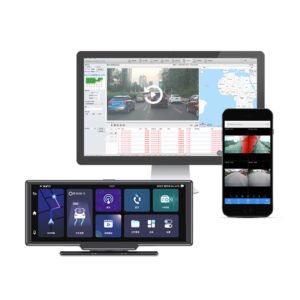
- Platform: footage and data land on a fleet management platform — in our units this is CMSV6-compatible, the widely used vehicle-video platform — where dispatchers see live map positions, receive alerts, play back history and download evidence.
- Act: managers get instant notifications, can talk to the driver (two-way audio on many models), mark and export evidence for insurance, and push firmware/settings updates over the air (OTA).
Key Features a 4G Dash Cam Adds Over a Normal One
- Live video streaming — see what any vehicle sees, right now, from anywhere.
- Real-time GPS tracking + route history — position, speed, stops and routes on a map.
- Instant event upload — G-sensor collisions, harsh braking/acceleration/cornering clips reach the platform within seconds, before the driver even calls in.
- Geofencing and route alerts — notifications when a vehicle enters/leaves a zone or deviates from a route.
- Remote evidence retrieval — download clips after an incident without visiting the vehicle or chasing an SD card (critical in hit-and-runs or when the driver is at fault).
- Optional AI: ADAS & DMS — forward-collision/lane-departure warnings on the road side, and fatigue, distraction, phone-use or smoking detection on the cabin side (how DMS compares to a traditional dash cam).
- Two-way audio and OTA management — talk to drivers and update hundreds of units remotely.
4G vs Wi-Fi Dash Cams — Don’t Confuse Them
A Wi-Fi dash cam connects only to your phone when you are within ~10 meters — great for personal users to download clips, useless for remote monitoring. A 4G dash cam connects everywhere there is cellular signal, which is what makes fleet-wide live management possible. Many 4G models include Wi-Fi too, for local clip download without burning data.
What About the Data Cost?
The SIM needs a data plan — typically a few GB per month per vehicle for event-based uploads and occasional live view, more for heavy live streaming. Most suppliers (including us) can ship units with pre-provisioned IoT SIMs or work with your local carrier; the platform side is usually a per-vehicle monthly subscription or a self-hosted server option. For fleets, this cost is small compared to what the system saves — our breakdown of how 4G fleet cameras reduce accident costs covers the numbers, and the broader case is in why fleet companies are moving to AI-connected cameras.
Who Actually Needs a 4G Dash Cam?
- Fleet and logistics operators — trucks, vans, delivery, long-haul: live tracking plus instant evidence is the core use case.
- Rideshare/taxi companies and franchise operators — cabin channel + remote clip retrieval handles passenger disputes without the driver “losing” the footage.
- Insurance and telematics providers — event data feeds directly into claims and UBI programs; SDK/API integration available.
- Construction, mining, hazardous transport — geofencing, DMS fatigue alerts and multi-channel coverage.
A private individual rarely needs 4G — a good 4K Wi-Fi model covers 99% of personal use (our dash cam buying checklist helps there). 4G is a business tool.
The Yeshi Tech 4G Lineup
- YC06 — 4G 4-Channel Fleet Dash Cam: our newest flagship, CMSV6 live streaming, GPS, optional ADAS/DMS — see the YC06 launch article.
- 4-Channel AI Fleet Cam with DMS + ADAS: maximum coverage and AI for high-risk fleets.
- 2K Triple-Channel 4G Fleet DVR: road + rear + cabin for rideshare and taxi fleets.
- YC03 — 4K front 4G dual-channel / YC04 — 2K front 4G / YC05 — 2K front + 720P rear 4G: dual-lens options across price tiers.
- YS09 — 4G LTE with remote live view: compact real-time tracking option.
Distributors and platform companies: we supply hardware with CMSV6-compatible platform support, API/SDK access, OEM branding and sample units — details for partners are in our OEM fleet camera solution overview.
Bottom Line
A 4G dash cam is a dash cam with a cellular connection that turns recorded video into live, remote, event-driven fleet intelligence. It costs more per unit and needs a data plan, but for any business running vehicles — especially at fleet scale — it changes what you can know, prove and prevent. For a single private car, it is overkill; for a fleet, it is rapidly becoming standard equipment.
Sourcing 4G Fleet Dash Cams?
Yeshi Tech manufactures 4G connected dash cams — dual, triple and 4-channel, with CMSV6-compatible cloud platforms, optional ADAS/DMS AI, GPS tracking and full OEM/private-label service for distributors, telematics companies and fleet operators. Ask us about platform accounts, SIM/data options and sample units — quote within 24 hours.
Email: sales01@yeshi3c.com
WhatsApp: +86 134 2511 8418
Address: Room 1006, Xianke Industry Building, Bagua 4th Rd, Futian District, Shenzhen, 518029, China
[…] It requires a data plan (usually a few GB/month of M2M/IoT data). For the full mechanics, see our what is a 4G dash cam and how does it work […]
[…] Management workflow — the output is not “a video file” but alerts, scores, reports and evidence that plug into how a fleet is run: safety programs, insurance claims, driver coaching and compliance. The connectivity side is explained in our 4G dash cam explainer. […]