
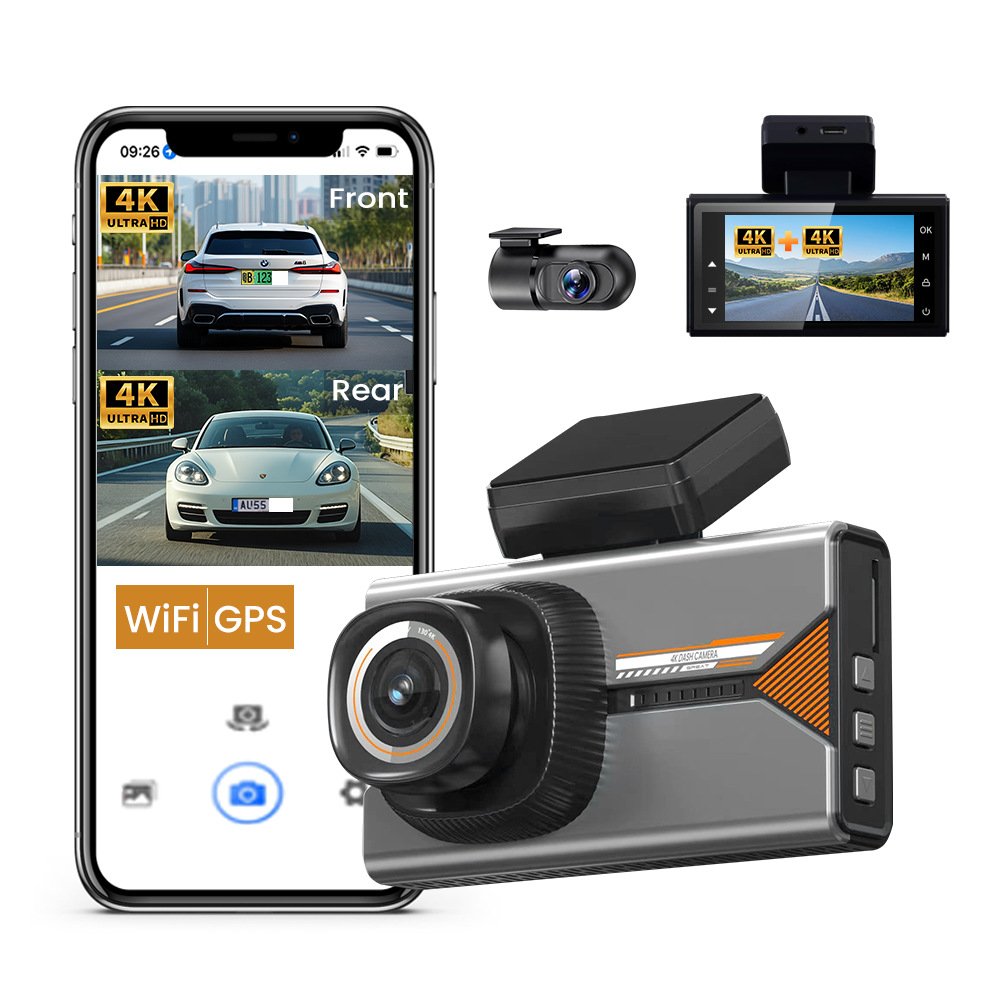
Resolution is the most quoted — and most misunderstood — dash cam specification. Here is what each tier genuinely delivers, without marketing spin.
The Tiers in Plain Numbers
- 1080p (Full HD, 1920×1080 ≈ 2.1 MP) — readable plates up to roughly 3–5 car lengths in daylight; compact files; the budget tier still acceptable for basic evidence.
- 2K (QHD, 2560×1440 ≈ 3.7 MP) — roughly 75% more pixels than 1080p. Noticeably better plate capture at distance and in dusk conditions; the current sweet spot for consumer front cameras. Our 2K 4G dash cam YC04 sits here.
- 4K (UHD, 3840×2160 ≈ 8.3 MP) — doubles 2K linear resolution. Plates become readable at 6–8 car lengths and the extra pixels survive digital zooming when reviewing footage. Our 4K dual-channel YS16 and 4K triple-channel YS15 use Sony STARVIS sensors to exploit those pixels in low light.
What Actually Determines Whether a Plate Is Readable
Resolution is necessary but not sufficient. Three factors matter equally:
- Sensor quality — a large STARVIS-class sensor at 2K often beats a cheap 4K sensor at night;
- Bitrate — a 4K file compressed to 15 Mbps loses the detail that 4K captured; look for 25–50 Mbps at 4K;
- Frame rate + HDR/WDR — 30 fps minimum, HDR to keep plates readable against headlights at night.
Storage: the Hidden Cost of Pixels
Bitrate drives card consumption: a 4K/50 Mbps camera fills a 128 GB card in roughly 5–6 hours of driving, so 256 GB (or H.265 compression) is the practical norm for 4K. Rear and cabin channels typically run 1080p and that is fine — distant plates matter mostly in the forward view.
Which to Choose per Market
Entry markets and gift retail still sell 1080p; mainstream consumer lines should target 2K as the value proposition; 4K is the premium differentiator, and multi-channel 4K front + 1080p auxiliaries is the current fleet standard. Distributor takeaway: sell the plate-reading story, not the megapixel number.
Frequently Asked Questions
Is 4K worth it over 2K for a dash cam?
If your customers review footage on computers (zooming into plates), yes — 4K’s extra pixels survive zoom. For small-screen playback only, 2K with a good sensor and high bitrate is the better value.
Do I need 4K on the rear camera too?
Usually not. The rear view mostly documents immediate proximity; 1080p–2K rear is standard and saves storage for the front channel.
Does higher resolution reduce recording time on the SD card?
Yes, roughly proportionally to bitrate — unless the camera uses H.265. Plan 128 GB minimum for 2K, 256 GB for 4K daily drivers.
Looking for a Dash Cam Supplier?
Yeshi Tech manufactures consumer and 4G fleet dash cameras for wholesale, OEM/ODM and private-label partners worldwide. Browse our full product range or request a quote — our engineers respond within one business day.
[…] The whole point of a dash cam is evidence: license plates, traffic lights, road signs, and what the other driver did. 1080p is the bare minimum; 4K front cameras make a real difference when you need to read a plate one or two cars ahead, especially in rain or at night. But resolution alone is not enough — look for a quality sensor (Sony sensors are the industry benchmark), a glass lens, and WDR/HDR to balance bright headlights against dark roads. Cheap “4K” cams with no-name sensors look worse than good 1080p ones after dark. We break this down in our 1080p vs 2K vs 4K resolution guide. […]
[…] measured these differences properly in our 1080p vs 2K vs 4K dash cam resolution guide — worth reading if you want the raw […]