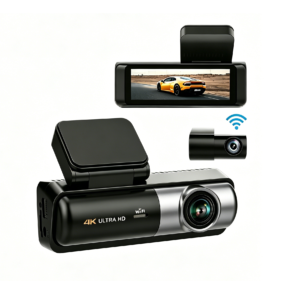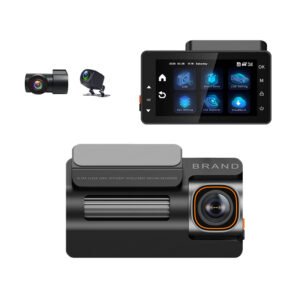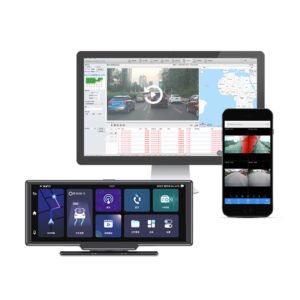
The short answer: for most everyday drivers, yes — but not for the reason the ads imply. A 4K dash cam is not about watching cinematic footage of your commute. It is about the one day you need to read a license plate, a traffic-light state, or a face at 20 meters, in bad light, from a moving car. On that day, the extra pixels either save an insurance claim or they do not. Here is the honest breakdown of when 4K pays off, when 2K is the smarter buy, and what matters more than the resolution number on the box.
What 4K Actually Gets You in a Dash Cam
4K (3840×2160) records roughly 4× the pixels of 1080p and about 2× that of 2K (2560×1440). In dash cam use, that pixel budget buys three concrete things:
- Readable plates at distance. A good 4K front cam can often make out a plate 15–25 meters ahead — one or two cars further than 1080p, which frequently means the difference between identifying a hit-and-run vehicle and not.
- Usable digital zoom and crop. When an incident happens off-center, you can crop into 4K footage and still have a sharp image; cropping 1080p footage gives you a blur.
- Better detail in low light and rain — but only when the sensor behind the lens is decent (more on that below).
We measured these differences properly in our 1080p vs 2K vs 4K dash cam resolution guide — worth reading if you want the raw comparisons.
When 4K Is Genuinely Worth It
- You drive in dense, lit-at-night traffic — city commutes, rideshare, delivery. Most disputes (lane changes, light-jumping, pedestrians) happen at night or in weather, exactly where extra resolution plus a good sensor matters most.
- Insurance claims are a real concern. If you are ever not at fault and the other driver lies, plate-level evidence ends the argument immediately. Fleets and professional drivers treat this as a cost of business; private drivers tend to appreciate it after the first near-miss.
- You want the camera to last 4–5 years. Resolution expectations rise; footage that looks “fine” today looks dated fast. 4K future-proofs the purchase.
- You run a rear or cabin channel too. Dual/triple 4K or 4K+1080P setups give you evidence in every direction — rear-end fraud (“brake-check” scams) and in-cabin disputes are exactly the incidents a single front cam misses.
When 2K (or Even 1080p) Is the Smarter Choice
- Tight budget. A good 2K dual-channel cam protects you far better than a cheap no-name “4K” cam with a junk sensor. Sensor and lens quality beat the resolution sticker every time.
- Short, daytime, low-speed trips in a small town — the marginal evidence benefit is small.
- You will use a small/old SD card. 4K eats storage roughly 2× faster than 1080p. Budget for a 128–256GB high-endurance card (see our microSD card guide for dash cams) or loop recording will overwrite clips too aggressively.
The Catch: “4K” on the Box Means Nothing by Itself
This is the part most listings hope you skip. Two cameras both labeled 4K can produce footage that is miles apart:
- The sensor is everything. A Sony-IMX-series sensor (e.g. IMX675) with WDR/HDR and a 6-glass lens will outperform a generic-sensor “4K” cam at night, where 90% of disputes happen. Ask what sensor is inside — sellers who cannot answer are telling you something.
- Bitrate matters. 4K at a starvation bitrate looks like 1080p with artifacts. Look for 4K recorded at a high bitrate with H.265.
- Heat kills cheap 4K cams faster. 4K processors run hot; behind a windshield in summer that matters. Prefer supercapacitor models over internal lithium batteries (why supercapacitors win in heat).
- Fake/interpolated 4K exists. Some budget units upscale 2K to 4K. Buy from a manufacturer that states the native sensor resolution.
Real-World Cost Difference
At factory/wholesale level, a reputable 4K single-channel cam typically costs only modestly more than a 2K equivalent — the gap has narrowed a lot in the past two years. For retail buyers the difference is often one or two tanks of fuel over a 4-year camera lifespan. For distributors and fleet buyers, 4K is now the mainstream spec: 2K is the value tier, 4K is the mid/standard tier, and 4G-connected multi-channel is the premium tier.
Our Verdict by Driver Type
- Budget personal / secondary car: 2K dual-channel is the sweet spot — e.g. the YS01 2K front & rear.
- Daily commuter who wants zero fuss: step up to 4K — the YS05 4K with 3.0″ IPS screen or YS10 with 3.16″ screen.
- Rideshare / taxi / night driving: 4K is worth it, and add cabin coverage — the YS15 4K triple channel with Sony IMX675 and IR cabin camera.
- Want front and rear at full quality: YS16 true front & rear 4K with reverse camera, or the YS14 4K+1080P with 5.8G Wi-Fi.
- Rideshare on a budget / night-vision priority: YS02 4K dual with enhanced night vision.
Bottom Line
If you drive regularly in traffic, drive at night, or rely on the car for work, a genuine 4K dash cam with a quality sensor is worth it — the evidence gap only matters once, and that once tends to be expensive. If the camera is for occasional local trips or the budget is tight, a good 2K unit beats a cheap fake-4K unit by a wide margin. Whatever resolution you pick, do not skip the basics that actually decide reliability: supercapacitor, high-endurance SD card, G-sensor lock and parking mode (full buying checklist here — and how loop recording, G-sensor and parking mode work).
Stocking Dash Cams? Get Wholesale Pricing & Samples
Yeshi Tech supplies 2K and 4K dash cams — single, dual and triple channel — to distributors, fleet operators and private-label brands worldwide, with CE/FCC/RoHS/UKCA certification and flexible OEM terms. Tell us your target quantity and market, and we will reply with a tailored quote within 24 hours.
Email: sales01@yeshi3c.com
WhatsApp: +86 134 2511 8418
Address: Room 1006, Xianke Industry Building, Bagua 4th Rd, Futian District, Shenzhen, 518029, China