Beyond resolution and channels, there is a form-factor choice that splits the dash cam market: the standard “wedge” camera that sticks to the windshield behind the mirror, versus the mirror dash cam that straps over (or replaces) your rear-view mirror and doubles as a large screen. Each has real advantages and drawbacks around visibility, discretion, installation and what you actually see while driving. Here is an honest comparison to help you pick. For the broader feature checklist, start with our dash cam buying guide.
What Each One Is
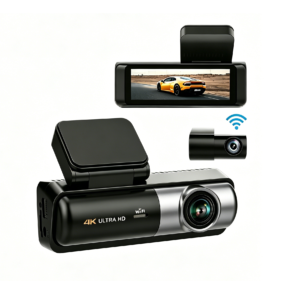
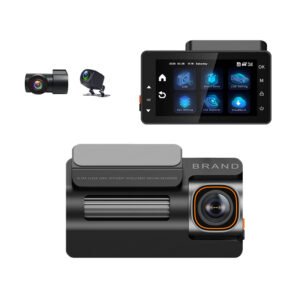
- Standard / wedge dash cam — a small compact camera mounted high on the windshield behind the rear-view mirror. It records to a card; you usually view footage on a phone app (Wi-Fi) or occasionally a small built-in screen. Sits out of sight. Most models — like the YS15, YS14 and YS02 — are this style.
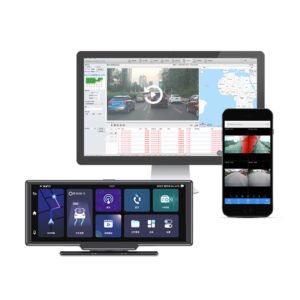
- Mirror dash cam — a unit that clips over your existing mirror (or replaces it) with a large touchscreen (often 7–12 inches). It records front and, usually, rear; the screen can show a live rear-camera feed, acting like a digital/streaming rear-view mirror.
Mirror Dash Cams: The Advantages
- Big live screen — the rear camera feed on a large display gives a wide, unobstructed view behind, even when the car is fully loaded with passengers/cargo blocking the normal mirror.
- Reversing aid — many switch to a full rear view with guidelines when you select reverse gear, helping parking and hitching.
- No windshield mount clutter — it lives on the mirror, so nothing new sticks to the glass; looks fairly factory.
- All-in-one — front + rear recording and a monitor in one package.
Mirror Dash Cams: The Drawbacks
- Visibility / distraction — a bright big screen in your eyeline can glare at night and draw the eye; many drivers turn the display off while driving (it still records).
- Fit and compatibility — it must strap securely to your mirror’s size/shape; on some cars it can sag, vibrate or block sensors/auto-dimming mirrors. Windshield-obstruction and mirror rules still apply (see mounting & legality).
- Sun exposure — the big screen sits in direct sun and heat; screen/electronics longevity in very hot climates is a consideration (relates to the heat-resilience point in our reliability guidance).
- Rear camera still needs a cable run to the back of the car — the mirror being up front doesn’t remove that wiring (coverage explained in front vs front-and-rear).
Standard Wedge Dash Cams: The Advantages
- Discreet / theft-deterrent — tucked behind the mirror, barely visible from outside or the driver’s seat; nothing glowing in your eyeline.
- No distraction, no night glare — no big screen; you drive normally and review clips on your phone.
- Proven, compact, heat-friendly form — small wedge bodies with supercapacitor build handle hot cabins well and last years.
- More channel/feature options — the widest choice of 2K/4K, 1–4 channel, GPS, ADAS/DMS and 4G cloud fleet units are wedge-style (channel options in the 1CH/2CH/3CH/4CH explainer).
Standard Wedge: The Drawbacks
- No big built-in monitor — you rely on the phone app for live view/playback (a plus for distraction, a minus if you wanted a reversing screen).
- A separate windshield mount (though it hides behind the mirror — placement guide here).
Side-by-Side
| Factor | Standard wedge | Mirror dash cam |
|---|---|---|
| Discretion / theft | Excellent (hidden behind mirror) | Visible as a big screen |
| Live rear view / reversing | No (app only) | Yes — big screen |
| Driver distraction / night glare | Minimal | Higher (can switch display off) |
| Fit risk | Universal windshield mount | Depends on mirror size/shape |
| Heat longevity | Strong (small, capacitor options) | Large screen in sun |
| Fleet / 4G / multi-channel | Widest choice (e.g. 4G fleet DVR) | Limited |
| Best for | Most drivers, fleets, discreet installs | Those wanting a reversing/live-rear screen |
Which Should You Choose?
- Choose a mirror dash cam if you specifically want a large live rear-view/reversing screen — e.g. you drive a van, SUV or car often loaded to the roof where the normal mirror is blocked, and you want an all-in-one monitor + recorder.
- Choose a standard wedge dash cam if you want discreet, distraction-free, reliable recording, the broadest resolution/channel/GPS/4G choices, and something that lasts in heat — which covers most private drivers and essentially all fleet/commercial use.
Either way, the fundamentals are the same: good night vision, a high-endurance card, and for 24/7 coverage a hardwire parking kit with battery protection (battery drain explained). For fleets, discreet wedge 4G units are the standard for a reason — remote evidence without a screen distracting the driver.
The Short Version
Mirror dash cams win if your priority is a big live rear-view and reversing screen, especially in vans or loaded vehicles; standard wedge dash cams win on discretion, low distraction, heat durability and the widest feature/channel/4G choice — and are the default for fleets. Both record front (and usually rear) equally well; the decision is about the screen and form factor, not the recording quality. Most drivers and all commercial operators are best served by a compact wedge unit like the YS15 or YS14 (or a 4G fleet DVR for business).
Standard & Multi-Camera Dash Cams — Driver, Fleet and Wholesale Pricing
Yeshi Tech supplies discreet wedge-style 4K dash cams, dual and triple-channel units and 4G connected fleet DVRs — with night vision, GPS and optional cloud — for drivers, fleets, distributors and OEM partners. Tell us your market and quantities — quote within 24 hours.
Email: sales01@yeshi3c.com
WhatsApp: +86 134 2511 8418
Address: Room 1006, Xianke Industry Building, Bagua 4th Rd, Futian District, Shenzhen, 518029, China