
It is the first real choice after you decide to buy a dash cam: one camera facing forward, or a second one covering the rear? A front-only camera is cheaper and simpler; a front-and-rear (dual-channel) setup costs a little more and adds a wire to the back of the car — but it covers the collisions that a forward camera completely misses. This guide lays out exactly what each setup does, who needs the rear lens, and how it extends to 3- and 4-channel systems. For the full feature checklist, see our dash cam buying guide.
What “Front-Only” and “Front-and-Rear” Mean
- Front-only (1-channel): a single camera on the windshield recording the road ahead. Simplest install, lowest price, one cable to power.
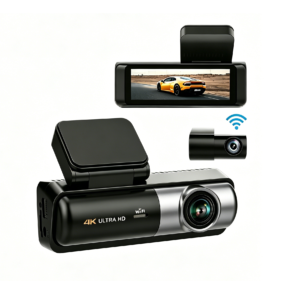
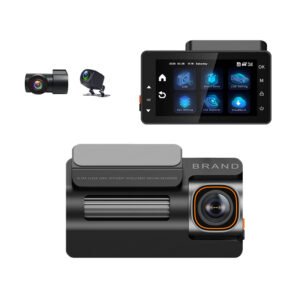
- Front-and-rear (2-channel / dual): the front unit plus a small rear camera — usually mounted on the rear windshield — connected by a long cable run along the headliner. Records both directions simultaneously to the same memory card.
Channels go further too: a 3-channel system adds an interior (cabin) camera, and a 4-channel adds side coverage as well. The full breakdown is in our 1CH/2CH/3CH/4CH explainer and what 4-channel systems are for.
Why the Rear Camera Matters More Than People Expect
A forward-only camera captures what happens in front of you — but a large share of incidents happen behind or around the car:
- Rear-end collisions — among the most common accidents. Without a rear camera, “they hit me from behind” is your word against theirs (and liability disputes get messy).
- Hit-and-runs while driving or parked — a vehicle striking you from behind and fleeing is only captured by a rear lens.
- Tailgating, aggressive drivers and lane-splitters approaching from the rear.
- Parking impacts — being reversed into in a lot (rear/parking coverage; see parking mode).
- Fake “you reversed into me” / insurance fraud from behind.
Rear footage also captures what the other vehicle did after a front collision — such as fleeing or changing position — which front-only footage cannot show.
Front-Only vs Front-and-Rear
| Factor | Front-only (1CH) | Front + rear (2CH) |
|---|---|---|
| Coverage | Road ahead only | Ahead and behind |
| Rear-end / hit-and-run evidence | ❌ Not captured | ✅ Recorded |
| Install | Simplest (power only) | Rear cable to back window |
| Price | Lowest | Slightly higher |
| Memory usage | One stream | Two streams (bigger card advised) |
| Best for | Budget, casual drivers | Most drivers, commuters, families |
Who Should Get Which?
- Front-only is fine if you are on a tight budget, drive rarely, or just want basic forward protection. It still captures the majority of at-fault-in-front incidents. A good value single/front option is the YS02.
- Front-and-rear is recommended for most drivers — commuters, families, anyone in dense traffic — because rear-end shunts and hit-and-runs are common and expensive to dispute without footage. The YS14 dual-channel (4K front + 1080p rear) is the natural step up.
- Rideshare / taxi drivers should go further to a 3-channel system with an IR cabin camera for passenger incidents — the YS15 or YS13 triple-channel; see our rideshare & taxi guide.
- Fleets and commercial operators benefit from 3- or 4-channel 4G units with cloud upload for full coverage and remote evidence — the 4G triple-channel fleet DVR; more in our fleet dash cam guide.
Practical Tips for Dual-Channel Setups
- Mount the rear camera high on the rear windshield, centred, for the widest view; route the cable behind the headliner and trim (professional install is quick and cheap).
- Night vision matters at both ends — the rear camera should also handle low light, since many rear incidents happen after dark (night vision guide).
- Use a bigger memory card — two channels write more data; 128GB minimum, 256GB for 4K dual setups (see the memory card guide).
- Wiring for parking mode (front and rear monitoring while parked) is covered in the hardwire kit guide.
The Short Version
A front-only dash cam covers the road ahead and suits budget buyers — but it cannot show rear-end collisions, hit-and-runs from behind, or what another car did after a crash. For most drivers a front-and-rear dual-channel camera is the sweet spot: modest extra cost for coverage in both directions. Drivers carrying passengers (rideshare/taxi) should add a cabin camera (3-channel), and fleets should look at 3–4 channel 4G units. Step up from a value front camera like the YS02 to a dual YS14, a triple YS15/YS13, or a connected 4G fleet DVR depending on what you need to protect.
Single, Dual and Multi-Channel Dash Cams — Driver, Fleet and Wholesale Pricing
Yeshi Tech supplies 1-channel, dual front+rear, 3-channel (with IR cabin) and 4-channel 4G fleet dash cams, with 4K front sensors, night vision and optional cloud upload — for drivers, fleets, distributors and OEM partners. Tell us the setup and quantities your market needs — quote within 24 hours.
Email: sales01@yeshi3c.com
WhatsApp: +86 134 2511 8418
Address: Room 1006, Xianke Industry Building, Bagua 4th Rd, Futian District, Shenzhen, 518029, China
[…] parking monitoring. If you are deciding between layouts, see how a two-channel setup compares in front-only vs front and rear dash cams, and why GPS logging strengthens insurance […]