
“2K or 4K?” is the first question on almost every dash cam order — and the spec sheet alone does not answer it, because the real difference is not just pixel count. It is how those pixels behave at night, at distance, in rain, on your SD card, and on your wallet. Below is a direct side-by-side comparison of 2K and 4K dash cams across every factor that actually matters.
The Numbers First
- 2K (Quad HD / 1440p): typically 2560×1440 pixels — about 3.7 million pixels per frame.
- 4K (Ultra HD / 2160p): 3840×2160 pixels — about 8.3 million pixels per frame, roughly 2.25× the resolution of 2K.
That sounds decisive, but in a dash cam the lens covers a 130–170° field and the subject (a plate) is a tiny part of the frame. What matters is how many pixels land on that plate — and that is where 4K’s advantage concentrates.
Side-by-Side: Where They Actually Differ
- License plate readability: 2K reads plates reliably at roughly 8–15 meters in daylight. 4K extends that to around 15–25 meters and holds up better when the car is moving or the plate is wet/dirty. In a hit-and-run that extra car-length of readable distance is often the whole game.
- Night footage: the gap narrows — and can even reverse — depending on the sensor. A 2K cam with a Sony sensor and good WDR often beats a no-name “4K” cam after dark. With equal-quality sensors, 4K still wins on detail. Never choose 4K on the label alone.
- Cropping / digital zoom: 4K footage can be cropped to half frame and still look like 1080p. Crop 2K the same way and it falls apart. If an incident happens at the edge of frame, this matters.
- Storage consumption: 4K uses roughly 1.8–2.5× the card space of 2K at similar quality settings. A 64GB card that holds ~8–10 hours of 2K may hold only ~4–5 hours of 4K. Plan for 128–256GB high-endurance cards in a 4K cam (SD card guide here).
- Heat and power: 4K processors run hotter and draw slightly more power. In a windshield-mounted device this matters in summer — which is why we strongly recommend supercapacitor models for 4K (supercapacitor vs battery).
- File transfer / Wi-Fi: 4K clips are bigger; pulling footage over 2.4GHz Wi-Fi is slow. 5GHz/5.8G Wi-Fi makes 4K painless; without it, expect to use the card reader.
- Price: the factory-level gap has shrunk to roughly 15–35% between comparable 2K and 4K models — much smaller than it was two years ago, but still real at retail and in fleet-sized orders.
Quick Comparison Table
| Factor | 2K (1440p) | 4K (2160p) |
|---|---|---|
| Pixels | 2560×1440 (~3.7MP) | 3840×2160 (~8.3MP) |
| Plate distance (day) | ~8–15 m | ~15–25 m |
| Night quality | Good with quality sensor | Best with quality sensor |
| Storage per hour | Lower (~6–8 GB/h) | Higher (~12–18 GB/h) |
| Recommended card | 64–128GB high-endurance | 128–256GB high-endurance |
| Heat load | Moderate | Higher — supercapacitor advised |
| Typical buyer | Budget personal, value tier | Commuter, rideshare, fleet standard |
So Which Should You Buy?
- Choose 2K if the budget is tight, the car is a secondary/short-trip vehicle, or you are equipping a large fleet where upfront cost per unit dominates and incidents are mostly low-speed. A YS01 2K dual-channel or the heavy-duty-commercial YS07 2K dual gives you solid evidence at the best price point.
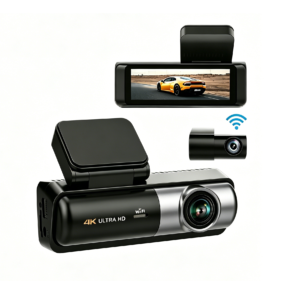
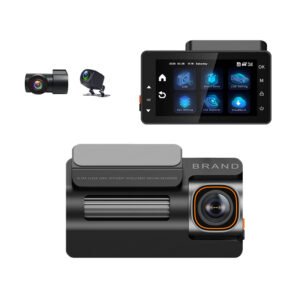
- Choose 4K if you commute in traffic, drive at night or for work (rideshare/taxi/delivery), want future-proofing, or are stocking the mainstream shelf — 4K is now the expected mid-tier spec. Pick from the YS05 4K with 3.0″ screen, YS10 with 3.16″ screen, YS02 with enhanced night vision, dual/triple-channel YS14 / YS16, or the top-of-line YS15 triple channel with Sony IMX675.
The One Rule That Overrides Resolution
A good 2K camera with a name-brand sensor, supercapacitor and high-endurance card will outperform a cheap 4K camera with a generic sensor and a lithium battery — every single time, and especially at night. Resolution is the most marketable spec, not the most important one. If you are still deciding, our is-a-4K-dash-cam-worth-it analysis and the full dash cam buying checklist walk through the decision; for how 1080p fits into the picture, see the 1080p vs 2K vs 4K comparison.
Bottom Line
2K and 4K differ by about 2.25× in pixels — but in practice the difference is one extra car-length of readable plate, much bigger files, and slightly more heat. Pay for 4K where evidence quality and night use matter; save with 2K where volume price and low-speed coverage dominate. Just never buy either resolution from a spec that cannot tell you what sensor is inside.
Ordering 2K or 4K Dash Cams in Bulk?
Yeshi Tech manufactures both 2K value-tier and 4K standard/premium-tier dash cams — single, dual and triple channel, with supercapacitor options, Sony sensors and CE/FCC/RoHS/UKCA certification. Distributors and fleet buyers get tiered pricing, OEM/private-label service and samples. Tell us your market and target quantity for a quote within 24 hours.
Email: sales01@yeshi3c.com
WhatsApp: +86 134 2511 8418
Address: Room 1006, Xianke Industry Building, Bagua 4th Rd, Futian District, Shenzhen, 518029, China
[…] that don’t say, usually don’t want you to know. We go into why this matters in our 2K vs 4K comparison and is 4K worth […]